






Class companion to the paper, made for teaching. Not commercial.

Read the plain version
A painting of a small boy on an orange shag rug, chin in his hands, smiling at a glowing walnut console television in a warm living room.

Childhood

Packaging Knowledge

Educational Content Creators, Sesame Street, and the Currency of Attention

Educational media only takes root when it reflects the dominant communication habits of its culture.

Scroll to begin
Sesame Street, Season 1 show open (8 seconds, muted).

The Blueprint (1969)

Selling the alphabet.

When Joan Ganz Cooney and the Children’s Television Workshop launched Sesame Street in 1969, they recognized that young children would never sit through static classroom lectures broadcast across a living room screen (Kearney & Levine, 2019; Krieger, 2026).

Joan Ganz Cooney, 1977.

Television was already established as an entertainment machine funded by commercial sponsors.

To keep young viewers from turning the channel dial, the workshop deliberately borrowed the animated visual gags perfected by commercial advertisers (Holiday, 2023; Krieger, 2026).

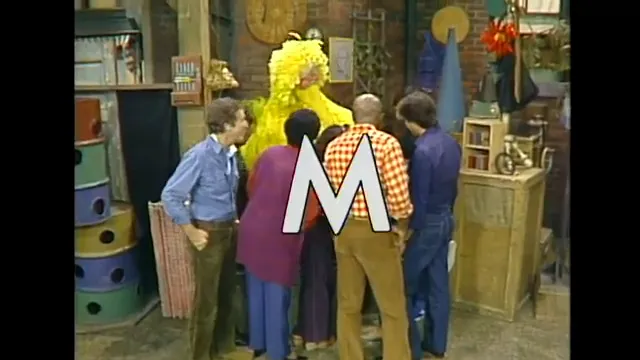
The show’s own sponsor sign-off: “Sesame Street has been brought to you today by the letters J and M and by the number five.” From “Goodbye, Mr. Hooper” (1983).
Sesame Street, Season 1 show open (8 seconds, muted).

Backed by foundational grants and federal funding through public broadcasting, the show used an entertainment tool families already owned to deliver cognitive growth and school readiness directly into low-income households for pennies on the dollar (Kearney & Levine, 2019; Krieger, 2026).

The breakthrough was not that television changed the fundamentals of human learning.

Instead, Sesame Street proved that mass educational media could succeed only by packaging intellectual instruction inside the commercial format that American culture already consumed.

  • Made by the Children’s Television Workshop (Joan Ganz Cooney and Lloyd Morrisett). First aired November 1969.Krieger, 2026
  • Funded by the Carnegie and Ford foundations, the Corporation for Public Broadcasting and the federal government.Krieger, 2026, Week 4 Lecture 4
  • About $5 per child per year (in today’s dollars).Kearney & Levine, 2019
  • Gains “particularly pronounced for boys and black, non-Hispanic children, along with those children who grew up in counties characterized by greater economic disadvantage.”Kearney & Levine, 2019

A painting of the same boy as a teenager in a teal sweater at a beige desktop computer, the green screen glow on his face, dusk light through the blinds.

Teen years

The screen shrinks

Just as Sesame Street revolutionized early childhood education in 1969 by appropriating the fast-paced techniques of television commercials, modern educational creators use digital video to turn presentation into the currency that buys viewer attention.

“In essence, Sesame Street was the first MOOC.”Kearney & Levine, NBER Working Paper 21229 (2015), p. 2

My foundational philosophy is that technology does not reshape society, it reveals society.

A painting of the same person at about 42, a working professional in a navy blazer, on a sofa at night, his face lit by the phone in his hand.

Today

Attention capital

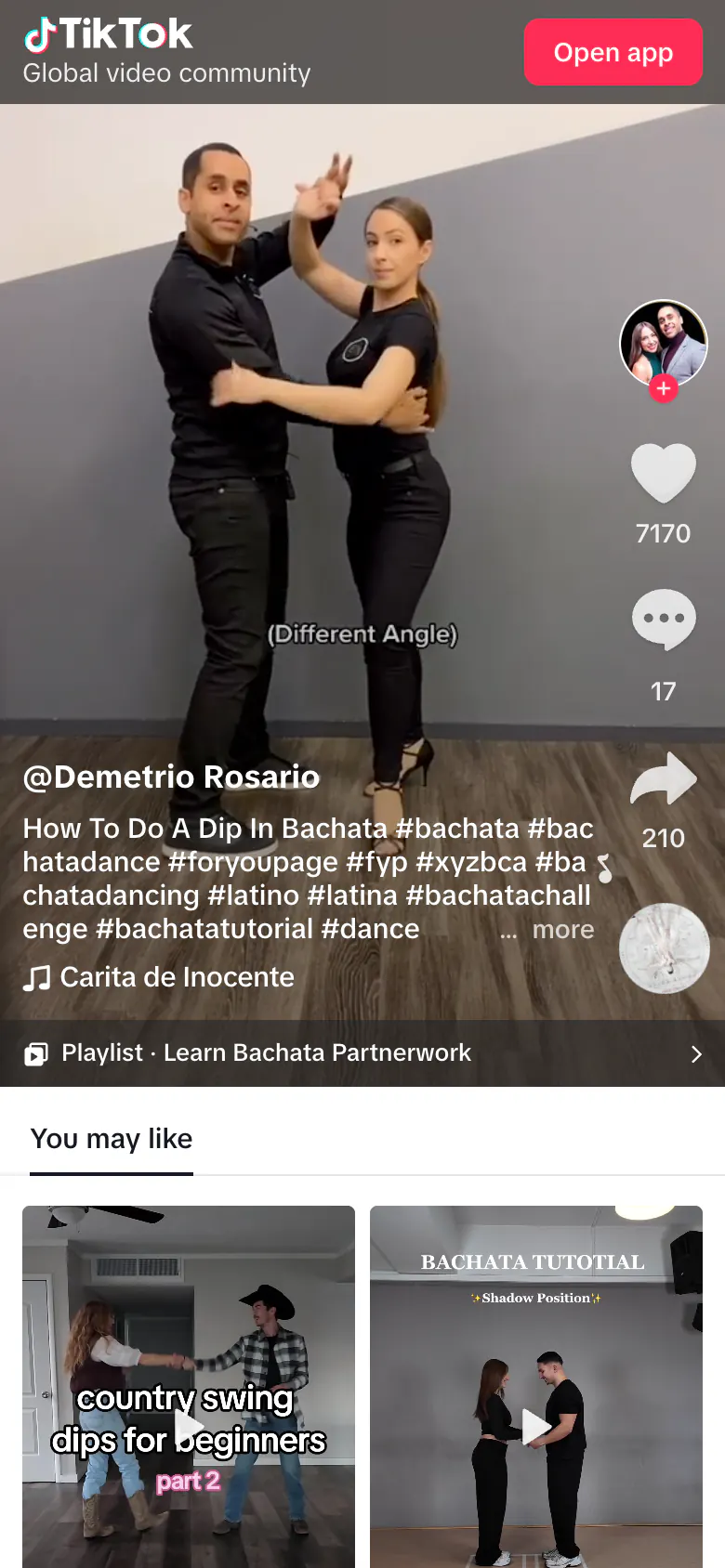
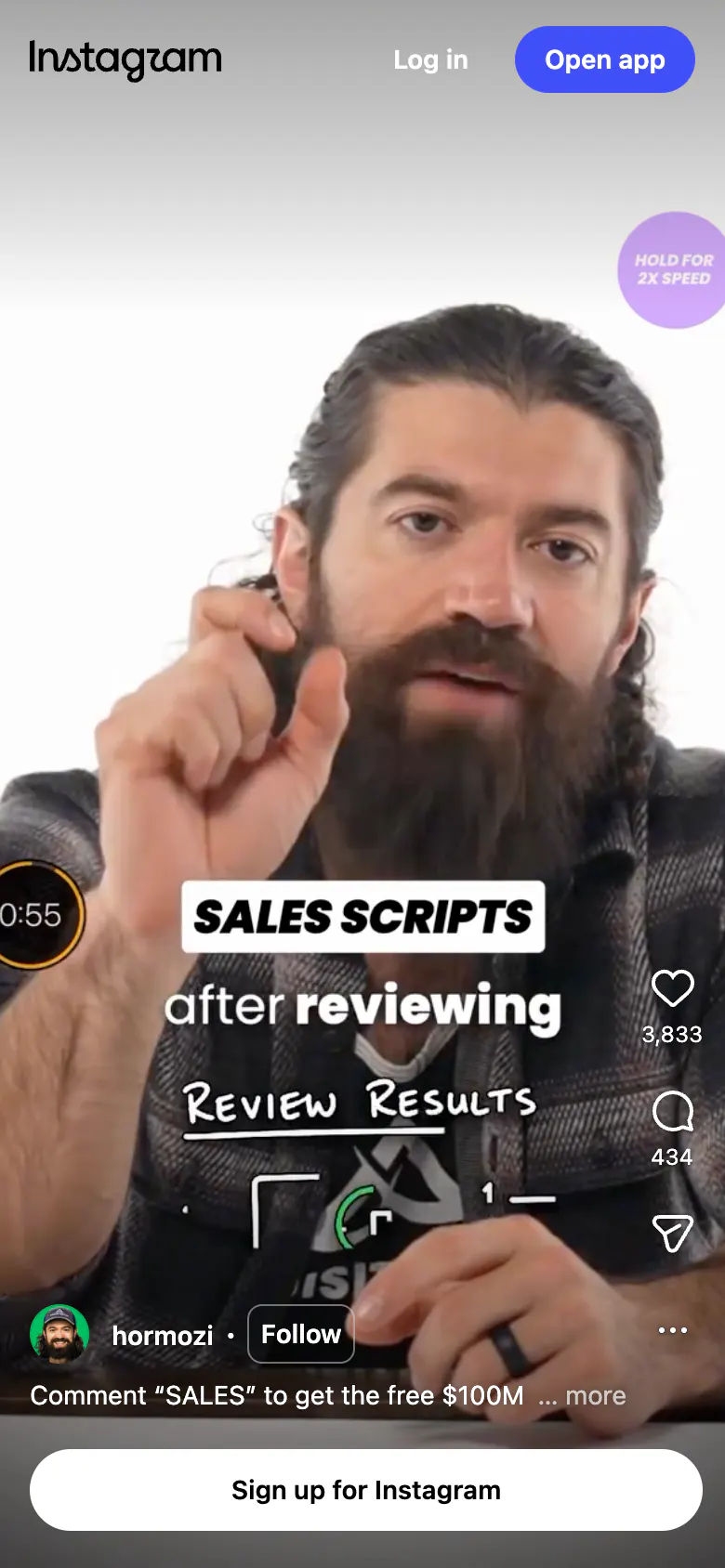
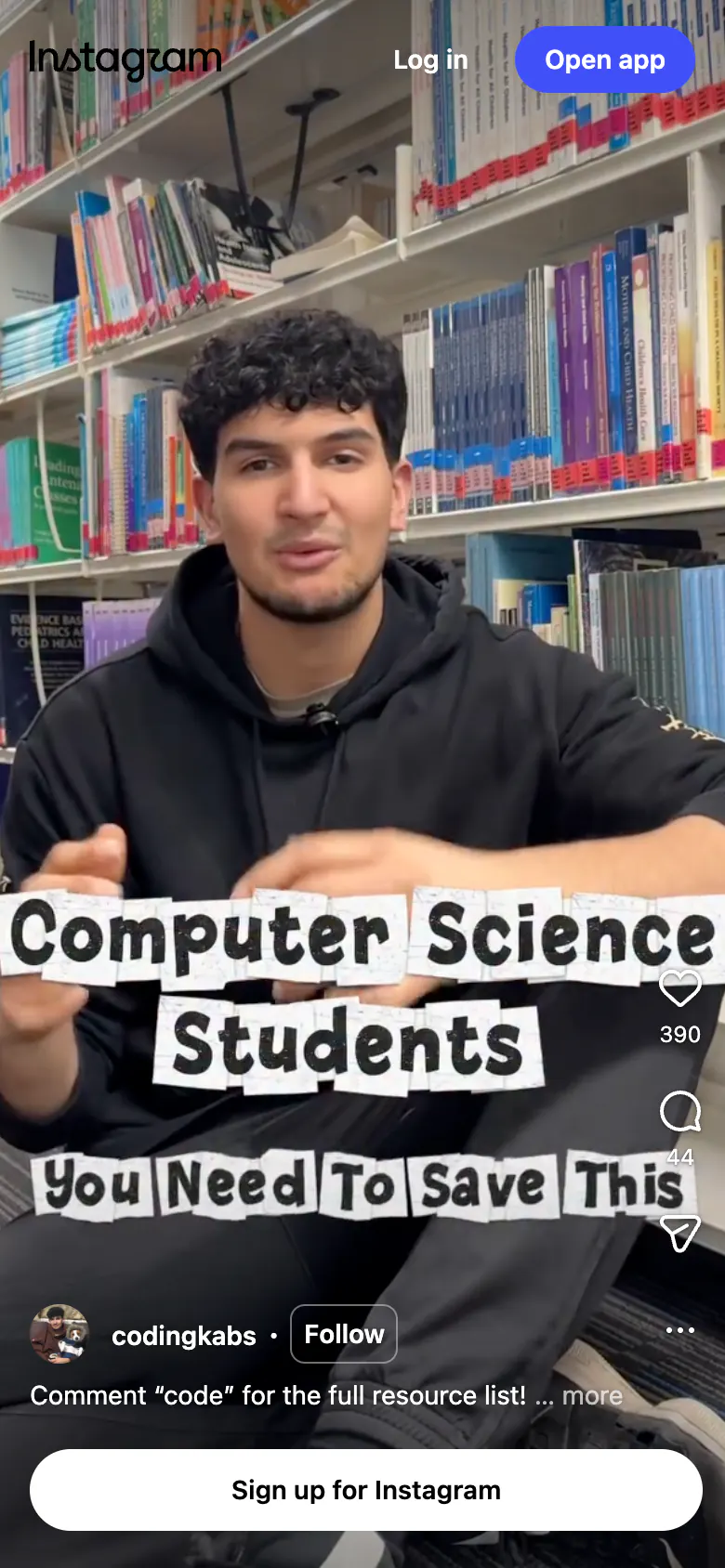
Modern educational content creators on YouTube, TikTok, and Instagram apply this exact commercial playbook to adult learning and professional skill-building.

  1. Modern platforms reveal an audience that demands visual speed, intentional visual short form video design, and friction-free delivery over traditional text-based study.

  2. In digital environments, presentation is the currency that buys attention, and investments are made where attention is paid.

  3. Because digital platforms offer scalable opportunities to monetize domain expertise, creators package complex subjects like computer programming, real estate finance, and corporate strategy into concise video breakdowns.

  4. They rely heavily on visual motion graphics and cognitive signalling cues to highlight critical points and maintain viewer focus (Alpizar et al., 2020, as cited in Forsström et al., 2025).

    • d = 0.38Signalling cues raise learning moderately
    • d = 0.47More for beginners
    • d = 0.50Moving cues beat still ones

    Alpizar et al., 2020, via Forsström et al., 2025, p. 33

    Each d is an effect size: how much the cues raised learning scores, where 0.2 counts as small, 0.5 as medium and 0.8 as large.

  5. In my own real estate business, I experienced this firsthand when I dove deep into watching YouTube videos about real estate investing, wholesaling, and negotiating real estate deals.

  6. That form of education paid dividends as I was able to close on my first off market real estate transaction and make a profit without a formal education.

  7. For the creators that do create content that make a tangible impact for their viewers, social media allows them to build independent businesses funded by advertising revenue, brand sponsorships, and private memberships.

  8. By building independent media channels, creators bypass the institutional gatekeeping of universities and academic publishers, bringing executive-level knowledge directly to everyday learners.

The trade-off

The democratization of bite-sized knowledge carries an unintended cultural consequence for intellectual depth.

Every technological gain produces a corresponding trade-off, echoing Neil Postman’s critique that recasting education into visual show business risks eroding the discipline required for analytical thought (Yardley, 1985).

Neil Postman’s three rules for teaching on television

  1. No prerequisites.
  2. No perplexity.
  3. No exposition.

Postman, via Yardley, 1985
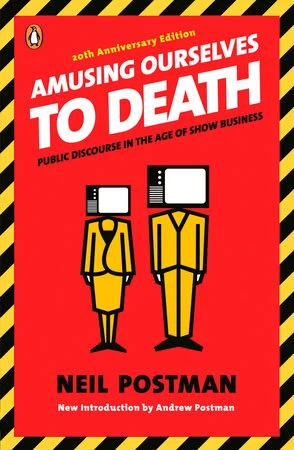
Neil Postman, Amusing Ourselves to Death (1985). Cover of the 20th anniversary Penguin Books edition.

Modern society increasingly bypasses traditional academic institutions to seek professional education from individual creators, evaluating the authority of information by subscriber counts and video likes rather than academic credentials.

While digital video offers immediate access, educational research shows that habitual screen-based micro-learning often encourages shallow skimming and undermines the cognitive endurance required for deep reading and sustained problem-solving (Hakemulder & Mangen, 2024, as cited in Forsström et al., 2025).

The challenge this presents is that viewers gain an immediate illusion of mastery from watching an entertaining ten-minute explainer, confusing the passive consumption of polished content with the hard work of practical execution.

This dynamic democratizes public access to specialized domain expertise across platforms, while catering to a culture that increasingly prefers effortless digital convenience over rigorous intellectual friction.

A watercolour of the same man the next morning at a desk by a sunny window, writing in an open book, his phone face down beside it.

Next morning

Doorway or substitute

The historical evolution from Sesame Street to algorithmic social video demonstrates that educational media always mirrors society’s appetite for convenience.

However, accessible presentation cannot replace the personal effort required to build genuine intellectual competence.

The true test of digital learning is whether audiences use bite-sized video as an initial doorway into deeper study, or treat entertaining summaries as a permanent substitute for authentic, disciplined mastery.

Works cited

  1. Forsström, S., Njå, M., Munthe, E., Álvarez-Galván, J.-L., & Houldsworth, L. (2025). The impact of digital technologies on students’ learning: Results from a literature review (OECD Education Working Papers No. 335). OECD Publishing. https://doi.org/10.1787/9997e7b3-en
  2. Holiday, S. (2023). How they got to Sesame Street: Children’s Television Workshop’s appropriation of advertising tactics for effective childhood literacy education. Journal of Early Childhood Literacy, 23(4), 529–557.
  3. Kearney, M. S., & Levine, P. B. (2019). Early childhood education by television: Lessons from Sesame Street. American Economic Journal: Applied Economics, 11(1), 318–350. https://doi.org/10.1257/app.20170300
  4. Krieger, M. (2026). DIGC 1600: A history of digital culture [Course lectures and video transcripts]. College of Liberal and Professional Studies, University of Pennsylvania.
  5. Yardley, J. (1985, November 2). The vacuum at the end of the tube. The Washington Post. https://www.washingtonpost.com/archive/entertainment/books/1985/11/03/the-vacuum-at-the-end-of-the-tube/790ab5db-51ee-4bd9-94ec-e2f2c7f1baeb/

Exhibit credits

Credits for what is shown on this page, not new sources. Real clips, photos, logos and screenshots of public creator posts appear here for teaching and commentary, each credited to its source.

  • Exhibit E1“Sesame Street: Show Open Season 1” (Season 1, first aired November 1969). Sesame Workshop. From the official Sesame Street YouTube channel (@SesameStreet), https://www.youtube.com/watch?v=jfQSp92L88I, accessed November 2026; 8 seconds, shown muted.
  • Exhibit E2“Sesame Street: Show Open Season 1” (Season 1, first aired November 1969). Sesame Workshop. Official Sesame Street YouTube channel (@SesameStreet), https://www.youtube.com/watch?v=jfQSp92L88I, embedded and played in YouTube’s own player as the background theme; nothing is hosted by this site. Accessed November 2026.
  • Exhibit E3“Goodbye, Mr. Hooper” (1983), closing sponsor announcement, 9 seconds. Sesame Workshop. From the official Sesame Street Classics YouTube channel (@SesameStreetClassics), https://www.youtube.com/watch?v=-GoEqVKjDHs, accessed November 2026.
  • Exhibit E5aJoan Ganz Cooney, 1977. Photo © Lynn Gilbert, CC BY-SA 4.0, via Wikimedia Commons.
  • Exhibit E5bCover of Amusing Ourselves to Death by Neil Postman (first published 1985), 20th anniversary edition (Penguin Books, 2005). © Penguin Random House. From penguinrandomhouse.com, accessed November 2026.
  • Exhibit E6YouTube icon © Google, from brand.youtube. TikTok icon © ByteDance, from the TikTok for Developers logo pack. Instagram icon © Meta, from Meta’s Instagram brand asset pack (2023). All accessed November 2026 and shown unaltered.
  • Paintings and filmThe painted world and its film: one fictional person, painted with Google Gemini (Nano Banana Pro) and set in motion with Google Flow (Veo 3.1 Lite), 2026, from prompts written with Claude Code.
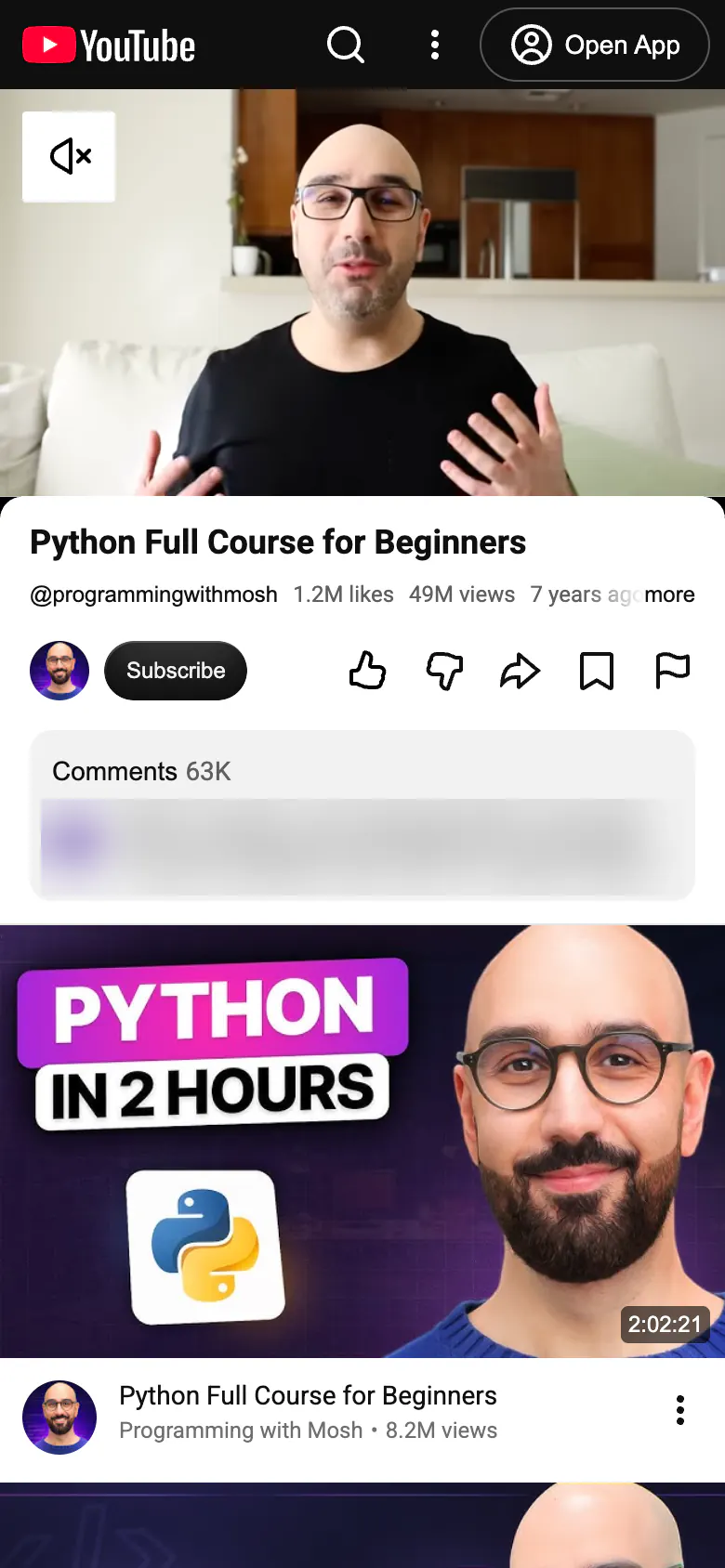
  • Feed screenshotProgramming with Mosh (Mosh Hamedani), “Python Full Course for Beginners” (YouTube, @programmingwithmosh). https://www.youtube.com/watch?v=_uQrJ0TkZlc. Screenshot of the public page as a phone shows it, with one viewer’s comment blurred; viewed November 21, 2026.
  • Feed screenshotTiff in Tech (Tiff Zhang), “What is the difference between Python and JavaScript?!” (TikTok, @tiffintech). https://www.tiktok.com/@tiffintech/video/7429505308604550406. Screenshot of the public page as a phone shows it, unaltered; viewed November 21, 2026.
  • Feed screenshotKabir Suri, “Comment “code” for the full resource list!” (Instagram, @codingkabs). https://www.instagram.com/reel/DepnsbvNMWG/. Screenshot of the public page as a phone shows it, unaltered; viewed November 21, 2026.
  • Feed screenshotAlex Hormozi, “Comment “SALES” to get the free $100M Sales Teams Training.” (Instagram, @hormozi). https://www.instagram.com/reel/Df7k2zOhoID/. Screenshot of the public page as a phone shows it, unaltered; viewed November 21, 2026.
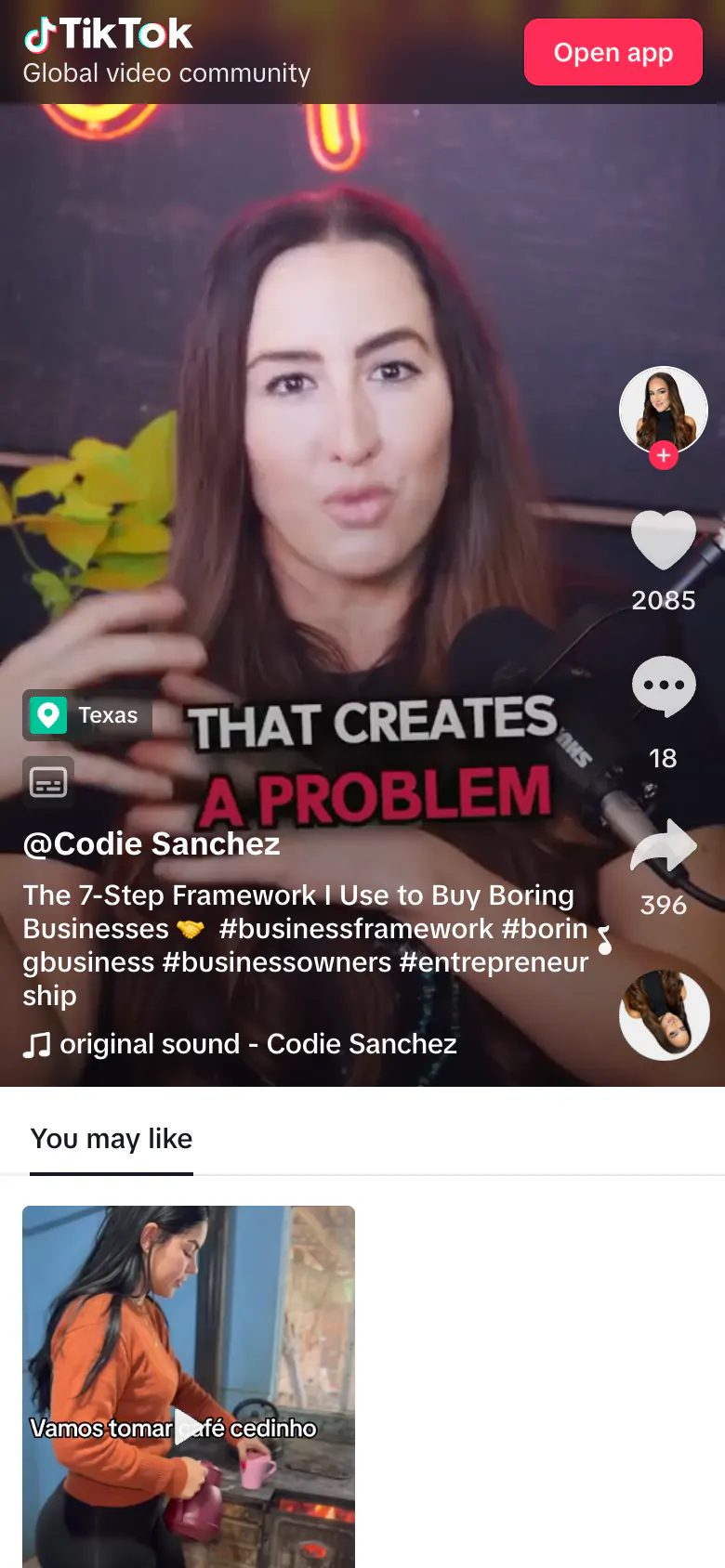
  • Feed screenshotCodie Sanchez, “The 7-Step Framework I Use to Buy Boring Businesses” (TikTok, @realcodiesanchez). https://www.tiktok.com/@realcodiesanchez/video/7280195483208043822. Screenshot of the public page as a phone shows it, unaltered; viewed November 21, 2026.
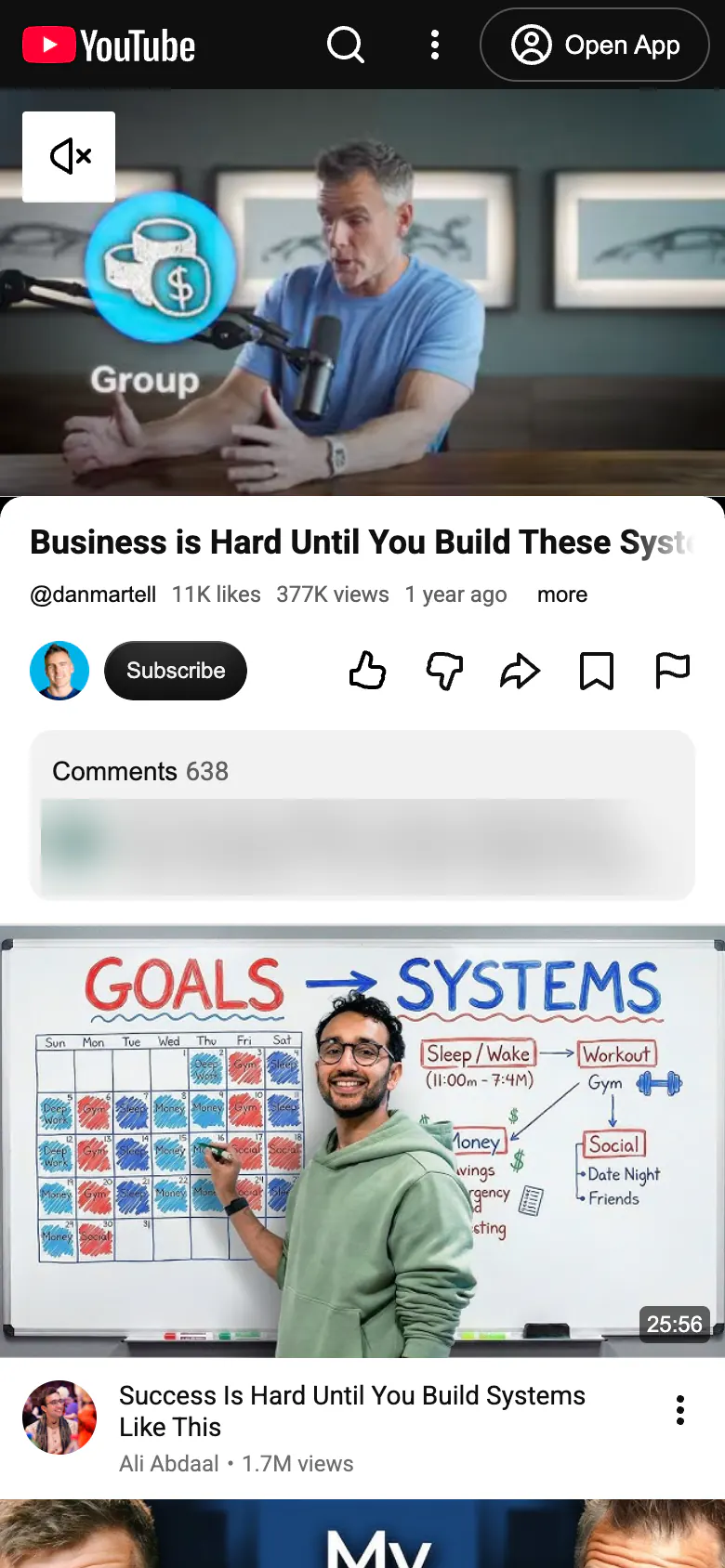
  • Feed screenshotDan Martell, “Business is Hard Until You Build These Systems” (YouTube, @danmartell). https://www.youtube.com/watch?v=eY9gpdaXW7w. Screenshot of the public page as a phone shows it, with one viewer’s comment blurred; viewed November 21, 2026.
  • Feed screenshotBiggerPockets, with Jamil Damji, “How to Start Wholesaling Houses (From Start to Finish)” (YouTube, @biggerpockets). https://www.youtube.com/watch?v=EH0Myr0nOYY. Screenshot of the public page as a phone shows it, unaltered; viewed November 21, 2026.
  • Feed screenshotPace Morby, “This is what to say to sellers… I see your home value, I see what you owe, I know you want to sell…” (TikTok, @pacemorby). https://www.tiktok.com/@pacemorby/video/7275751932881423634. Screenshot of the public page as a phone shows it, unaltered; viewed November 21, 2026.
  • Feed screenshotPace Morby, “A simpler starting point than house wholesaling” (Instagram, @pacemorby). https://www.instagram.com/reel/Df2eddHFLyn/. Screenshot of the public page as a phone shows it, unaltered; viewed November 21, 2026.
  • Feed screenshotDemetrio Rosario (Demetrio & Nicole, Bachata Dance Academy), “How To Do A Dip In Bachata” (TikTok, @demetriorosario). https://www.tiktok.com/@demetriorosario/video/6907675722530245893. Screenshot of the public page as a phone shows it, unaltered; viewed November 21, 2026.
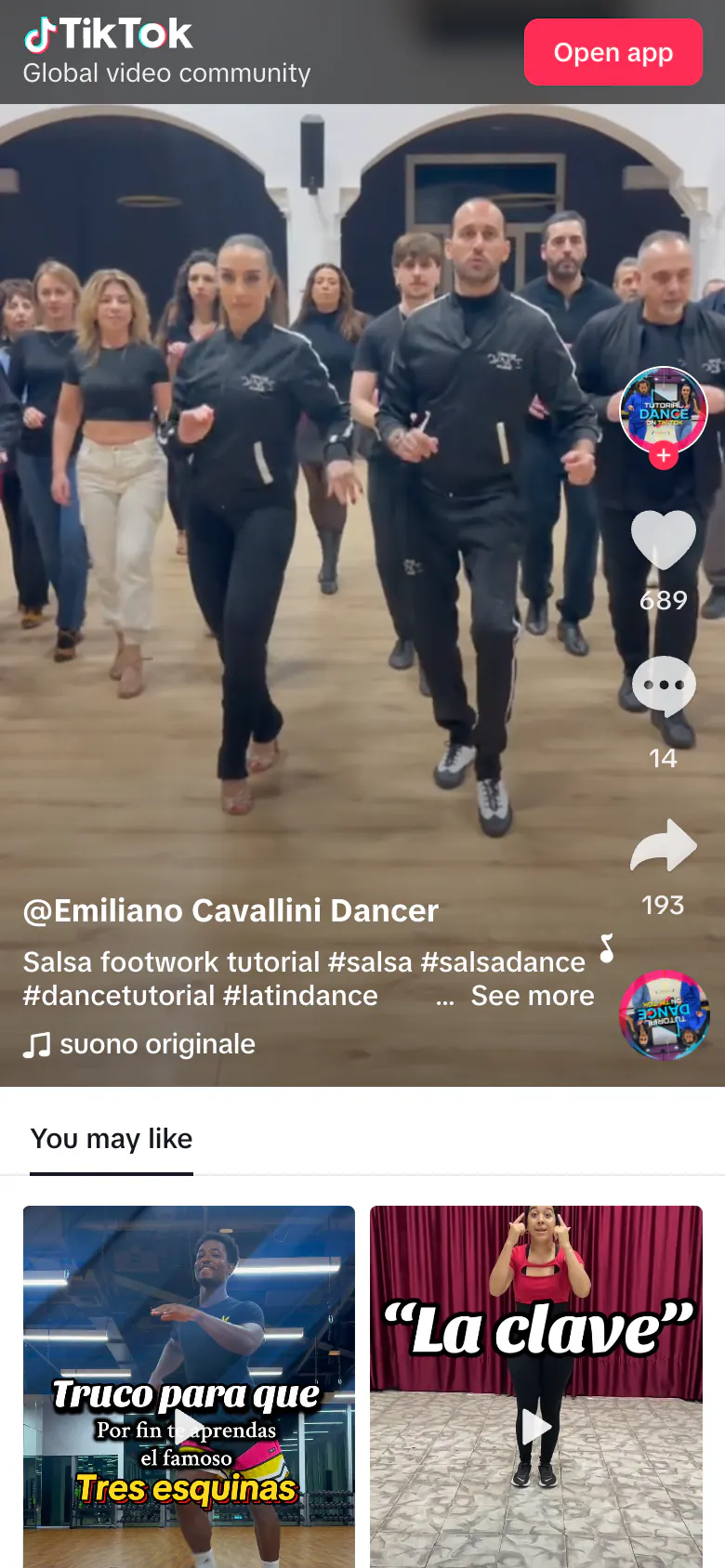
  • Feed screenshotEmiliano Cavallini, “Salsa footwork tutorial” (TikTok, @emilianocavallini). https://www.tiktok.com/@emilianocavallini/video/7472070672366259478. Screenshot of the public page as a phone shows it, unaltered; viewed November 21, 2026.

The person in the paintings is fictional and resembles no real person.